Why understanding what matters to people can make all the difference to AI adoption.
In my previous article, I explored why successful AI adoption starts with understanding people, rather than simply giving them access to technology, tools and training.
But that raises another important question:
How do we help people see the possibilities of AI and discover what it could mean for them?
When organizations introduce AI, there is often a strong focus on communicating its benefits, demonstrating its capabilities and encouraging people to get involved.
We talk about productivity, efficiency, innovation and the opportunity to work differently. We show people what AI can do and explain why it matters.
But successful adoption requires something more than communicating the possibilities. It requires understanding the people we want to bring along on the journey.
People respond to change based on what they believe, what they value, what they have experienced and what they need.
And much of that sits beneath the surface.
Think about an iceberg.
What we see above the water is only a small part of what exists beneath it. The same can be true when we look at people's reactions to AI.
We might see someone questioning the value of AI, taking a cautious approach, avoiding training or continuing to work in familiar ways.
These are visible behaviours, but they don't necessarily tell us what is driving them.
Above the surface: What we see
"I don't need AI."
"AI can't do my job."
"I don't trust the answers it gives."
"It's just another technology initiative."
"I prefer doing things myself."
Not attending training or experimenting with available tools. Getting access to AI but making little use of it.
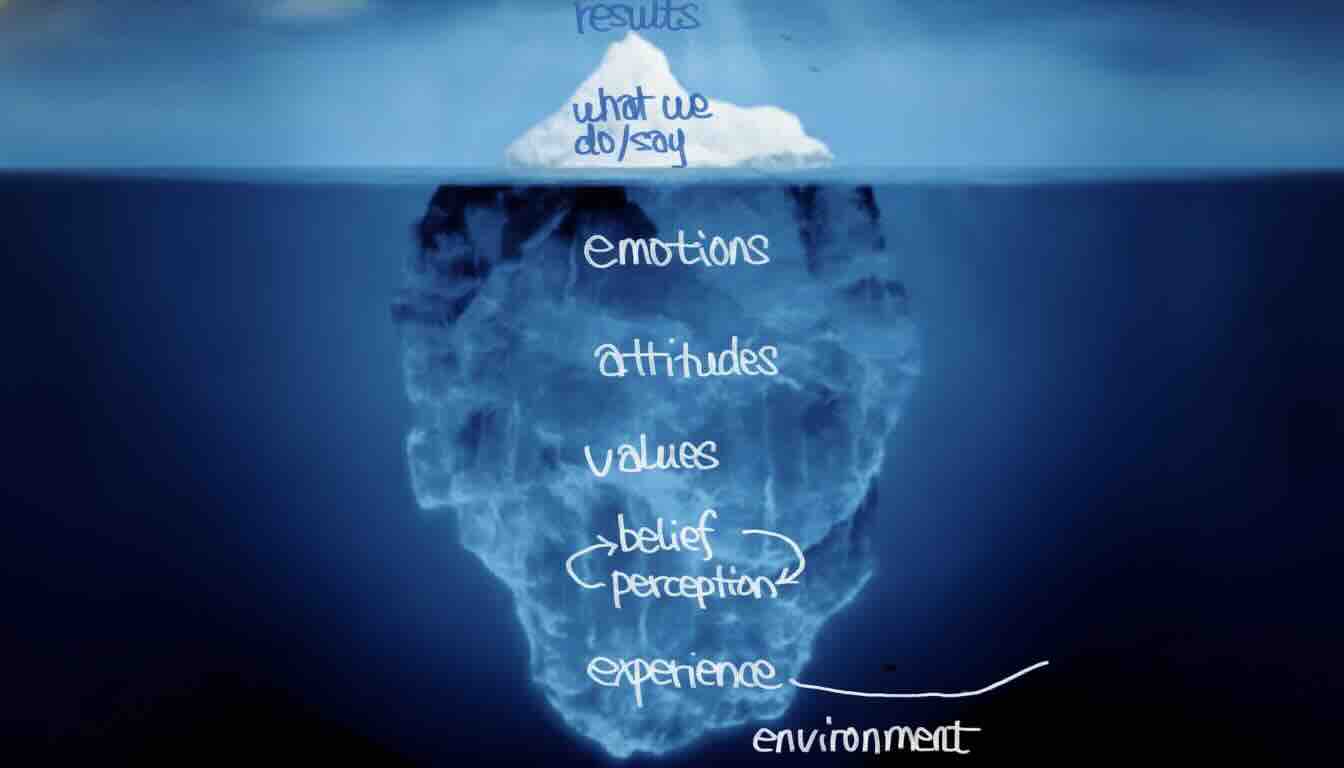
Beneath the surface: What might be influencing those behaviours
Values: A strong belief in human connection, professional expertise, quality or craftsmanship.
Beliefs: The perception that AI cannot produce reliable results or understand the complexity of their work.
Mindset: A preference for familiar ways of working, or a belief that technology changes too quickly to keep up with.
Attitudes: Scepticism, uncertainty, indifference or frustration towards AI.
Needs: A desire for security, stability, control, competence or reassurance.
Past experiences: Previous technology initiatives that promised a lot but created additional work or delivered little value.
Identity: A sense of professional worth closely connected to knowledge, skills and expertise that AI might appear to challenge.
These are possible explanations, not assumptions about every individual. Two people can display exactly the same behaviour for completely different reasons.
Understanding these underlying factors gives us a much better starting point for meaningful conversations about AI.

One thing I find particularly interesting about AI adoption is that people can have very different relationships with the technology.
Some are genuinely curious and want to explore everything it can do. Others are more cautious and need time to understand its relevance.
There are also people who are keen to get access to AI tools, perhaps because they don't want to miss out, but once they have access, they don't necessarily make much use of them.
They might try a few things, use it as a search engine or writing assistant, but never really explore how it could support their wider responsibilities or change the way they approach their work.
There is nothing wrong with these uses. They can be useful starting points. But access and curiosity don't automatically translate into meaningful adoption.
Sometimes, people simply haven't found a problem they want AI to help them solve.
And that is an important distinction.
People are more likely to engage with AI when they can see how it connects to something that matters to them.
Imagine telling someone how AI can save them hours every week when they don't feel particularly overwhelmed by their workload. Or demonstrating how AI can automate a task when that task is something they enjoy doing and take pride in.
You might be presenting a compelling case from the organisation's perspective, but the individual may not see the same value.
The opportunity isn't to create a need for AI. It is to understand what matters to people and explore whether AI can genuinely help.

Instead of starting with:
"Have you tried this new AI tool?"
"You should be using AI to save time."
"Look at what AI can do."
"You need to start embracing AI."
What if we started with different conversations?
What parts of your work take the most time?
Which tasks do you find repetitive or frustrating?
What would you like to spend more time doing?
What do you enjoy most about your role?
Where do you think technology could genuinely help you?
What concerns or questions do you have about using AI?
What would help you feel comfortable experimenting with it?
These questions shift the focus away from the technology and towards the individual.
They also help us identify genuine opportunities for AI to add value.
For one person, it might be reducing time spent preparing reports. For another, it could be organizing information, exploring ideas or getting started on a difficult piece of work. Someone else may not identify an obvious use case at all, and that is a conversation worth having too.
The point is not to convince everyone that AI is the answer. It is to help people discover where it might be useful, while recognizing where it might not be.

One of the deeper considerations in AI adoption is professional identity.
For many people, their knowledge, experience and expertise are central to how they see themselves and the value they bring to an organisation.
They have spent years developing their skills, building relationships and becoming good at what they do.
So, when AI is introduced with messages about automation, efficiency or doing things differently, it is understandable that some people might question what this means for them.
Will my experience still matter?
Will my skills become less valuable?
Will the work I take pride in be replaced? Will I still be needed?
These questions may not always be expressed openly, but they can influence how people respond.
This is why the way we communicate about AI matters.
If we focus only on replacing tasks, reducing effort or doing more with less, we risk overlooking the human contribution behind the work.
Instead, we need to help people understand how AI can complement their expertise, support their judgement and create opportunities to focus on the aspects of their work where human insight makes a difference.
AI should not be presented as a replacement for the value people bring. We should explore how it can help them apply that value differently.
Understanding what matters to people requires curiosity, listening and empathy. It also means creating opportunities for people to explore AI in ways that feel relevant to them.
Here are five things leaders can do differently:
1. Be curious and listen
When someone is sceptical or uncertain about AI, take the time to understand their perspective.
Ask questions and listen to what is behind their response. You might discover that their concern isn't about AI itself, but about quality, security, workload or the impact on their role.
2. Understand what people value
Find out what people care about in their work. What gives them satisfaction? Where do they feel they add the most value? What are they proud of?
These conversations can help identify where AI might support them while preserving what matters most.
3. Connect AI to real opportunities
Rather than presenting generic demonstrations, explore the tasks, frustrations and opportunities that are relevant to people's everyday roles.
The more relevant the application, the easier it becomes for someone to see a reason to engage.
4. Build confidence through experience
Not every question or concern can be addressed through explanation alone. Give people opportunities to experiment, ask questions and discover what AI can do in a supportive environment.
Practical experience can help turn uncertainty into understanding and build confidence over time.
5. Recognize that adoption is personal
There is no single message or approach that will resonate with everyone. People have different motivations, experiences and starting points.
Some may need reassurance. Others need inspiration, practical support or simply the opportunity to explore at their own pace.
Our job as leaders is to understand what will help each person move forward.

AI adoption is often approached as a communication and training challenge. We explain the technology, demonstrate its capabilities and encourage people to use it.
But perhaps we need to spend more time understanding the person on the receiving end of those messages.
- What do they value?
- What do they believe?
- What are they interested in?
- What motivates them?
- What experiences have shaped their attitudes towards the change?
Because the behaviour we see is not always the whole story.