Why introducing AI is as much about understanding people as it is about introducing technology.
There is a lot of excitement about what AI can do. Organisations are investing in tools, providing licences, running training sessions and encouraging employees to explore how AI could transform the way they work.
And rightly so. AI presents significant opportunities to rethink processes, improve productivity and create new ways of working.
But there is a question I think we need to spend more time considering:
Are people actually adopting AI, or are we simply giving them access to it?
Through my own observations, I have noticed a range of different responses to AI adoption.
Some people are genuinely curious and eager to explore what it can do. Others are more sceptical or reluctant. Some are keen to get access to AI tools, perhaps because they don't want to miss out, but once they have access, they don't necessarily know what to do with them or how to incorporate them into their work.
Others might try AI once or twice, use it for a quick search or to help write something, and then return to their familiar ways of working.
And then there are those who actively resist it.
To illustrate the potential scale of this challenge, we could consider a hypothetical workforce where around 20% actively resist AI adoption, another 30% are cautious or sceptical, and the remaining 50% are more open to experimenting or adopting it.
These are illustrative planning assumptions rather than universal research findings. However, they highlight an important point: a significant proportion of employees may not be naturally enthusiastic about adopting AI.
And we shouldn't necessarily expect them to be.
There are legitimate concerns about job security, the value of professional expertise, accuracy, accountability and what AI might mean for the future of work. There is also the simple reality that people have established ways of working, and changing those habits takes effort.
Access is not adoption. Awareness is not desire. And trying AI once is not the same as integrating it into the way we work.

When organizations see limited AI adoption, the natural response is often to provide more training, demonstrations or guidance.
These things are important, but they don't always address the real issue.
We can teach people how to use AI, show them what it can do and provide access to the latest tools. But what if they don't see why they should use it? What if they don't believe it will help them? Or what if they are concerned about what using AI might mean for their role or professional expertise?
The challenge may not be a lack of knowledge. It may be a lack of motivation, confidence, trust or perceived relevance.
People don't all respond to change in the same way. What feels like an exciting opportunity to one person may feel like an unnecessary disruption to another.
Some may be worried about being replaced. Others question the quality of AI-generated outputs. Some simply don't see a compelling reason to change their existing processes.
These are very different challenges, and they shouldn't all be addressed in the same way.
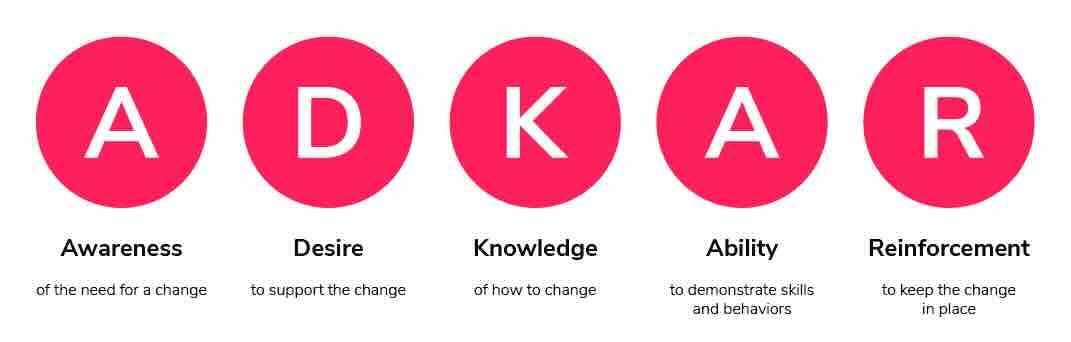
One useful way to think about this is through the ADKAR model, developed by Prosci. It provides a framework for understanding the individual elements people need to move through when experiencing change.
ADKAR stands for Awareness, Desire, Knowledge, Ability and Reinforcement.
1. Awareness – Do people understand why change is needed?
It's not enough to tell employees that AI is the future or that the organisation wants to become more innovative. They need to understand why AI is relevant to their work and what problem or opportunity it is intended to address.
Without this context, AI can feel like another initiative being introduced from the top.
2. Desire – Do people want to be part of the change?
This is perhaps one of the most important, and often overlooked, elements of AI adoption.
Understanding why change is happening doesn't automatically mean people want to participate in it.
Some may be excited by the possibilities. Others may be uncertain, sceptical or concerned about what AI means for their role and expertise.
We shouldn't dismiss these concerns or assume that resistance is simply a negative attitude towards technology.
People need to see a reason to engage. They need to understand what is in it for them, how AI might help them and why it is worth changing something they already know how to do.
We cannot assume that providing access to AI will automatically create the desire to use it.
3. Knowledge – Do people know how to change?
Once people understand the reason for change and are willing to participate, they need the knowledge to move forward.
This is where training, guidance and practical learning become important. People need to understand how to use the tools, assess their outputs and use AI responsibly.
But knowledge alone isn't enough. Someone can understand how a tool works and still not feel ready to use it in their everyday role.
4. Ability – Can people put their knowledge into practice?
Knowing how to use AI is different from applying it effectively in real working situations.
People need opportunities to practise, experiment and build confidence. They also need time, support and an environment where they can ask questions and learn from mistakes.
The important thing is to help people move from understanding what AI can do to discovering what it can do for them.
5. Reinforcement – What helps people sustain the change?
Adoption needs to be supported over time.
If people experiment with AI but don't see lasting value, they may quickly return to familiar ways of working.
Leaders need to recognise progress, share useful examples and encourage continued learning. AI adoption isn't a one-off training exercise; it is an ongoing journey.

When I look at these five elements, one pattern I see is that organizations can sometimes jump in to fast without considering human aspects.
Some organizations don't provide the necessary guidance and training on AI, which doesn't enable knowledge and ability.
Some other organizations provide licences, organize training, share prompts and demonstrate the latest capabilities. But if someone doesn't understand why they need AI, doesn't see its relevance or doesn't want to change the way they work, more training may not make much difference.
We cannot solve a motivation problem with more training.
Someone who is curious but lacks confidence needs different support from someone who understands the technology but sees no reason to adopt it.
And someone who is actively concerned about the implications of AI may need a very different conversation altogether.
This is an important distinction for leaders. We need to understand where people are in their change journey rather than assuming everyone needs the same intervention.

Rather than starting with the question, "How do we get everyone using AI?", perhaps we should start by asking:
- What do people understand about why we are introducing AI?
- What are they excited about, and what are they concerned about?
- How could AI be relevant to their own work?
- What would make them want to explore it?
- What knowledge and support would help them build confidence?
These questions encourage us to listen before we try to persuade.
Not everyone needs to become an AI expert, and not every task needs to involve AI. The goal should be to help people understand where AI can add value, make informed choices and develop the confidence to use it appropriately.
As leaders, our role is not simply to introduce the technology. It is to create the conditions in which people can understand, explore and make the change themselves.

AI adoption is often discussed in terms of technology, tools, productivity and efficiency. But behind every implementation are people who need to understand what is changing, why it matters and what it means for them.
If a substantial proportion of employees are uncertain or reluctant, simply providing more tools and training is unlikely to deliver the adoption organizations are hoping for.
ADKAR reminds us that successful change requires more than knowledge and technical capability. It requires awareness, desire, ability and ongoing reinforcement.
And perhaps the most important starting point is recognising that people don't resist change for no reason. There is usually something behind their response that we need to understand.