AI is changing not only how quickly we can build products, but also how effectively we can discover which products are worth building.
Organizations are increasingly exploring how AI can improve product development, enhance existing offerings and create new business opportunities. Much of the attention, however, is focused on using AI to accelerate design, development and delivery. An equally important opportunity lies earlier in the product lifecycle: discovering what customers actually need, identifying problems worth solving and determining which ideas have the greatest potential.
Product discovery has traditionally involved customer research, interviews, surveys, workshops, brainstorming, market analysis and experimentation. These activities help product teams understand customer needs, explore possible solutions and make informed decisions about where to invest.
AI introduces new ways to support this process. It can analyze large volumes of information, identify patterns, explore alternative perspectives and help teams evaluate opportunities more efficiently. It can also make it easier to challenge assumptions, investigate emerging needs and test ideas before committing significant development resources.
The objective is not simply to generate more ideas or produce more prototypes. It is to make better product decisions and increase the likelihood of building something that customers genuinely value.
Successful products start with a clear understanding of customers: who they are, what they need, what problems they experience and what they are trying to achieve.
Organizations collect valuable information through customer interviews, surveys, support requests, product reviews, feedback forms and usage data. However, this information is often spread across different systems and formats, making it difficult and time-consuming to identify meaningful patterns.
AI can help bring this information together and make it easier to analyze. It can summarize customer interviews, categorize feedback, identify recurring complaints, highlight emerging needs and uncover patterns that might otherwise be difficult to recognize.
For example, an organization could use AI to analyze customer support conversations and product feedback to identify recurring difficulties with an existing product. It might reveal that customers are struggling with a particular workflow, requesting similar capabilities or using the product in ways that were not originally anticipated.
AI can also help explore differences between customer segments, identify underserved groups and investigate how customer expectations are changing.
These insights provide a stronger starting point for product discovery. Rather than relying only on assumptions or isolated feedback, product teams can use a broader evidence base to understand where meaningful opportunities may exist.

Understanding existing customers is important, but product discovery should also look beyond the current customer base.
Markets evolve, new technologies emerge, competitors introduce alternative solutions and customer expectations change. These developments can create opportunities for new products, improved services or entirely different ways of delivering value.
AI can help analyze market trends, competitor offerings, industry developments, emerging technologies and changing customer expectations. It can bring together information from multiple sources, summarize developments and identify potential gaps in the market.
For example, a product team could use AI to investigate how a particular industry is changing, which problems remain unresolved and where existing solutions fall short. It could explore opportunities created by new technologies or identify customer segments that are not adequately served.
Once potential opportunities have been identified, AI can also act as a creative thinking partner. It can help generate ideas, challenge assumptions and explore alternative solutions. Teams can use it to compare different approaches, identify potential limitations and consider perspectives that may not have been explored.
For example, a team investigating how to simplify a complex customer process could use AI to explore several possibilities: improving an existing workflow, introducing an intelligent assistant, automating selected activities or developing an entirely new service.
The value is not simply generating more ideas. It is expanding the range of possibilities and helping teams identify solutions that are more closely aligned with customer needs.
AI-generated ideas are starting points for exploration, not validated product concepts. Human creativity, domain expertise and critical thinking remain essential.
Identifying potential opportunities and generating ideas are important, but not every idea is worth pursuing.
A solution may sound compelling but fail to address a meaningful customer problem. Another may solve a real problem but be too difficult or expensive to implement. Others may be technically achievable and attractive to customers but lack a sustainable business case.
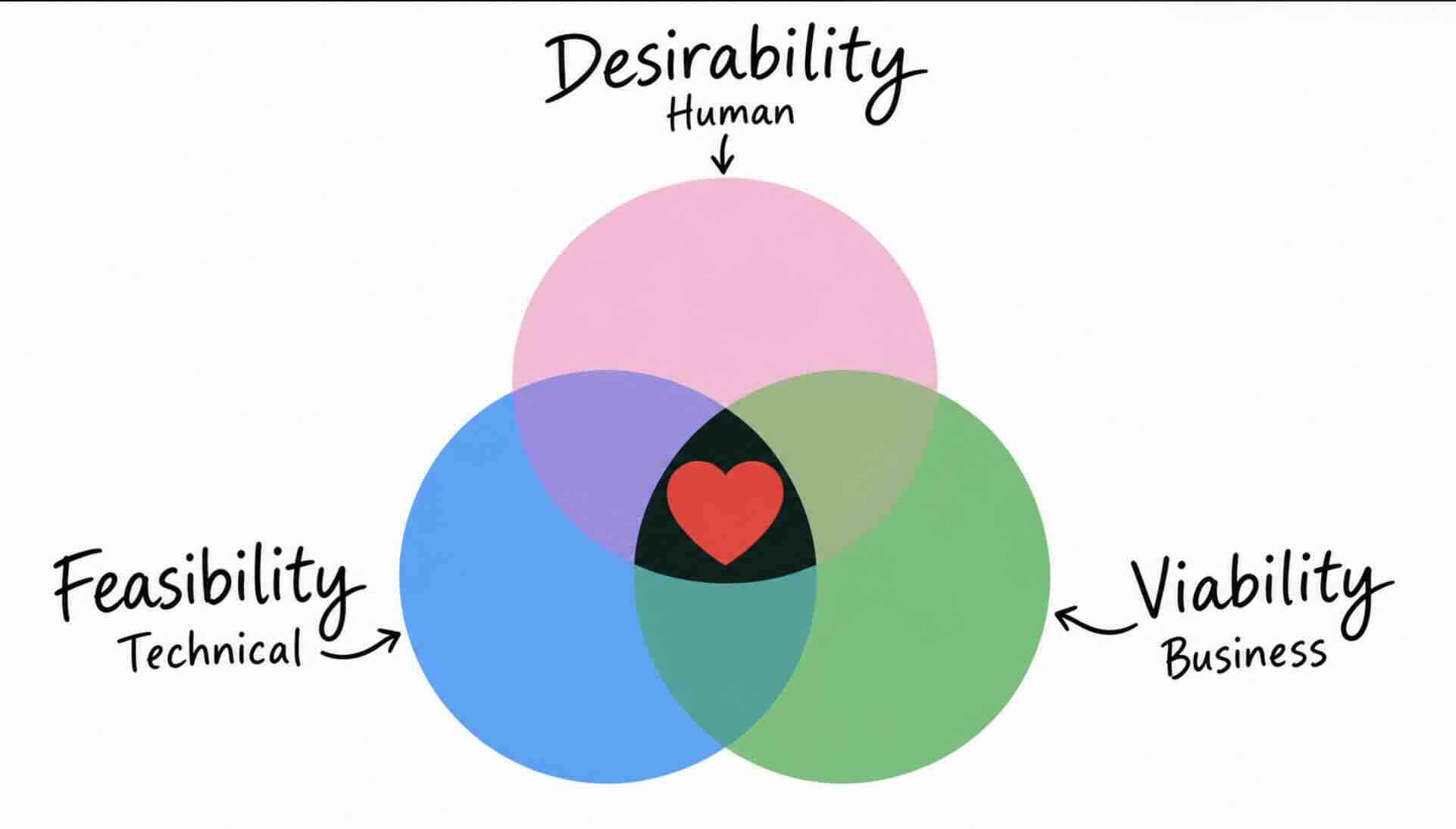
A useful way to evaluate product opportunities is through three interconnected dimensions: desirability, feasibility and viability.
Desirability – Do customers want or need it?
Desirability focuses on understanding customers, their problems, unmet needs and expectations.
Does the proposed solution address a meaningful problem? Is it better than the alternatives customers already have? Would customers be willing to adopt and use it?
AI can help analyze customer interviews, surveys, product feedback and usage data to identify recurring problems, emerging needs and patterns in customer behaviour. It can also help explore different customer segments and challenge assumptions about their priorities.
Feasibility – Can we build and deliver it?
Feasibility considers whether the proposed solution can realistically be developed and delivered.
This includes technical feasibility, available data, integration requirements, skills, resources, infrastructure, security and regulatory considerations.
AI can support technical research, explore alternative architectures, assess implementation approaches, identify dependencies and highlight potential constraints. It can also help teams investigate whether AI is actually the right technology for solving the problem, rather than assuming that every opportunity requires an AI-based solution.
Viability – Does it make business sense?
Viability looks at whether the opportunity can create sustainable value for the organization.
Does it align with the business strategy? Is there a sufficiently attractive market? Can the organization develop a sustainable revenue model? Are the expected benefits proportionate to the investment, operating costs and risks?
AI can help explore market information, compare business models, assess competitors, estimate potential costs and identify commercial assumptions that need further investigation.
The strongest opportunities sit at the intersection of all three dimensions: customers want or need the solution, the organization can realistically deliver it, and there is a sustainable business case for doing so.
AI can make this evaluation faster and more evidence-informed by helping teams gather information, compare alternatives, challenge assumptions and identify gaps. However, the responsibility for evaluating trade-offs and deciding which opportunities to pursue remains with the product team and the organization.
Once an opportunity has been identified and evaluated, the next step is to explore whether a proposed solution can deliver the expected value.
Traditionally, developing prototypes and testing concepts can require significant time and resources. AI can help accelerate this work by supporting the creation of mockups, user journeys, test scenarios, demonstrations and interactive prototypes.
It can also help prepare interview questions, structure experiments, analyze feedback and identify areas where a concept needs improvement.
For example, a team exploring a new digital service could use AI to develop an initial prototype and test different user journeys before committing to full development. Feedback from potential customers could then be analyzed to identify usability issues, missing capabilities or assumptions that need further investigation.
This makes it easier to explore alternatives, learn from feedback and refine concepts earlier in the product lifecycle.
There is, however, an important distinction between simulated feedback and real customer validation. AI can simulate possible user reactions or help anticipate questions, but these outputs should not be treated as evidence of actual customer demand.
Real validation requires engaging with customers, observing how they respond to the solution and understanding whether it addresses their needs.
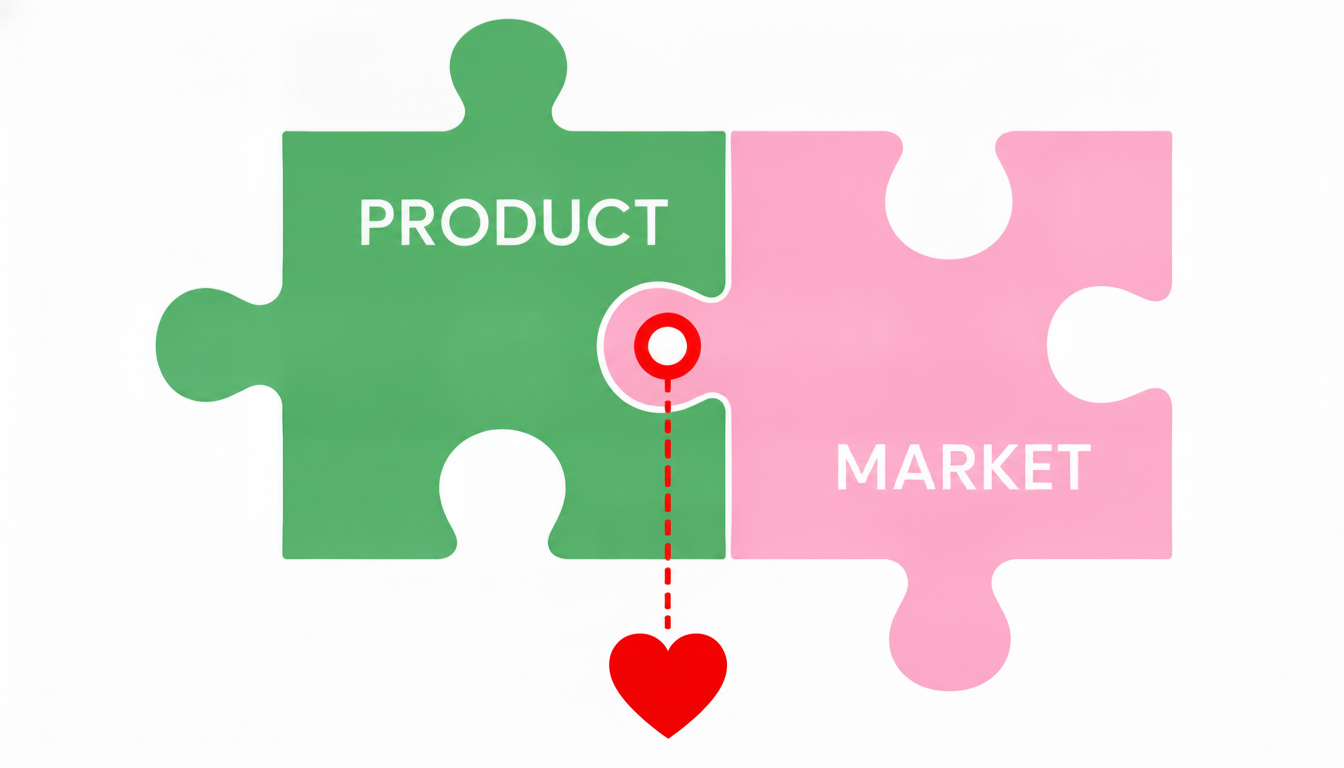
Identifying an opportunity that appears desirable, feasible and viable is an important step, but it does not automatically mean that a product will succeed.
The next challenge is establishing product-market fit: demonstrating that a product meets a real market need and delivers enough value for customers to adopt it, continue using it and, where relevant, pay for it.
This requires more than market research or an assessment of potential demand. It requires testing ideas with real customers, developing prototypes or minimum viable products, gathering feedback, observing actual usage and refining the offering based on what is learned.
AI can accelerate this process by helping generate prototypes, prepare experiments, analyze customer feedback, identify patterns in usage data and highlight areas where the product may not be meeting expectations.
However, product-market fit cannot be established through AI analysis alone. It must be demonstrated through evidence from real customers and their behaviour.
Product discovery should therefore be viewed as an ongoing process rather than a one-time activity. As customer needs, market conditions and technologies evolve, organizations need to continuously reassess desirability, feasibility and viability and determine whether their products continue to deliver meaningful value.